

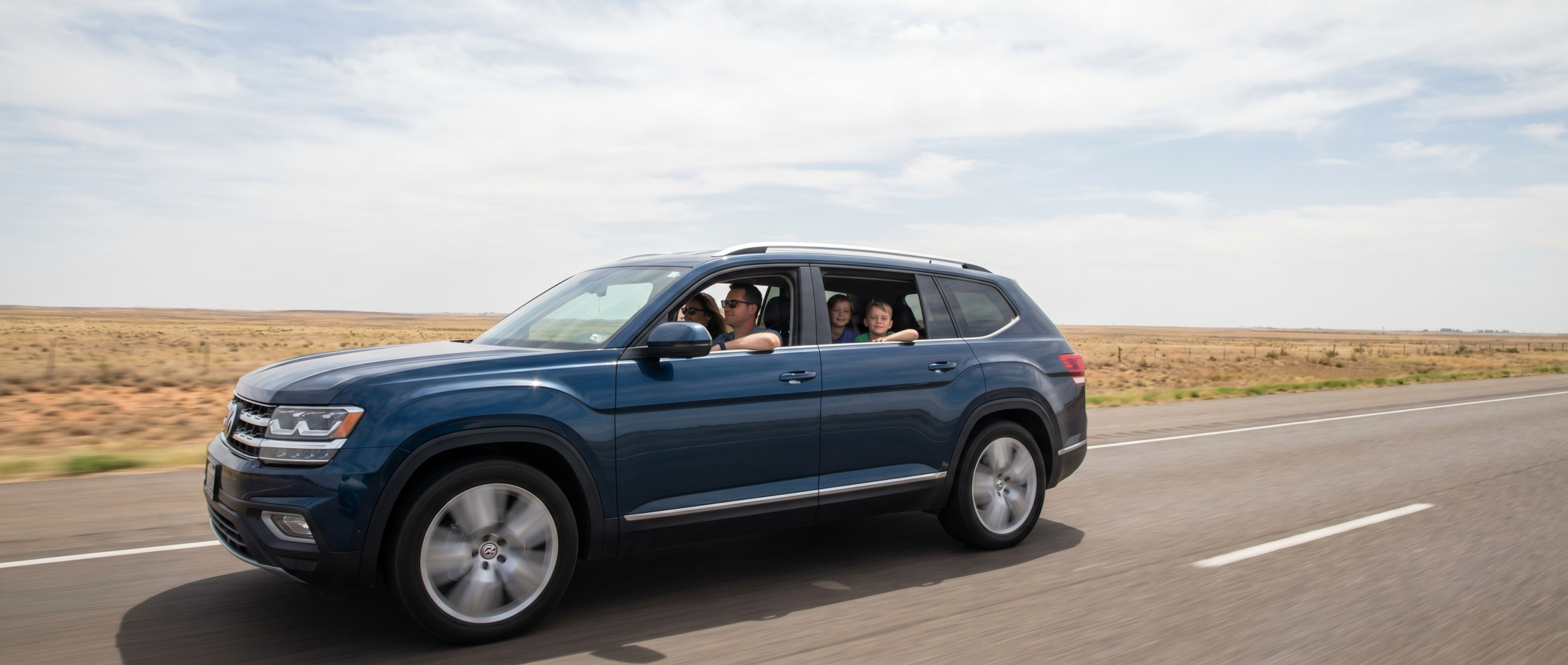
The 177-mile stretch of I-40 through the Texas Panhandle tests every vehicle that crosses it – and the Volkswagen Atlas turns this challenge into its greatest showcase. Whether you’re hauling the family to Cadillac Ranch or pushing through to Albuquerque, this three-row SUV transforms endless highway miles into comfortable journeys. For drivers in Amarillo, TX who regularly face long stretches of open road, understanding how the Atlas performs where it matters most – on I-40 – makes all the difference in choosing the right family vehicle.
Why I-40 Through the Panhandle Demands a Different Kind of SUV
Wind gusts averaging 15-20 mph year-round make I-40 through Potter and Randall Counties particularly demanding on vehicles – which is precisely where the Atlas’s 5,037-pound curb weight becomes an advantage. This substantial mass, combined with the SUV’s wide stance, creates remarkable stability even when semi-trucks create turbulent air pockets. The Atlas maintains its composure where lighter crossovers get pushed around.
The flat terrain might look easy, but the combination of sustained highway speeds, crosswinds, and temperature extremes creates unique challenges:
- Constant headwinds reduce fuel efficiency by up to 25% in typical vehicles
- Temperature swings from 20°F winter mornings to 100°F summer afternoons stress mechanical systems
- Limited service stations between Amarillo and Tucumcari mean reliability matters more
- Monotonous scenery for hours demands superior comfort to combat driver fatigue
Residents commuting between Canyon and downtown Amarillo understand these conditions aren’t occasional – they’re daily reality. The Atlas addresses each challenge through engineering specifically suited to long-distance highway driving.
Real-World Fuel Economy Between Amarillo and Major Destinations
| Destination | Distance from Amarillo | Atlas V6 Fuel Used | Typical Fuel Stops | Drive Time |
|---|---|---|---|---|
| Oklahoma City, OK | 260 miles | 10.4 gallons | 1 (optional) | 3 hrs 45 min |
| Albuquerque, NM | 290 miles | 11.6 gallons | 1 recommended | 4 hrs 15 min |
| Dallas, TX | 360 miles | 14.4 gallons | 1 required | 5 hrs 30 min |
| Denver, CO | 425 miles | 17.0 gallons | 1-2 required | 6 hrs 30 min |
The Atlas V6 achieves 23-25 MPG on I-40 under real conditions – not just EPA estimates. With its 18.6-gallon tank, you’ll pass numerous gas stations before needing to stop, providing flexibility to choose stations with better prices or cleaner facilities.
Cross-referencing fuel consumption with actual Atlas owners driving through the Panhandle reveals the AWD models typically see only a 1-2 MPG decrease compared to FWD versions. This minimal penalty makes AWD worth considering for those who also navigate unpaved roads near Lake Meredith or Caprock Canyons State Park.
Comfort Features That Matter After 300 Miles
By the time you reach the New Mexico border, inferior seats reveal themselves through backaches and numbness – but the Atlas keeps occupants comfortable well past the 5-hour mark. The driver’s seat offers 12-way power adjustment including 4-way lumbar support, addressing the lower back strain that develops on flat, straight highways.
The Atlas provides comfort advantages that become apparent on long hauls:
- Tri-zone climate control prevents the common “too hot in back, too cold in front” battle
- Panoramic sunroof (available on SE trim and above) combats the claustrophobic feeling of endless highway
- Ambient lighting in 10 colors helps reduce eye strain during pre-dawn or night drives
- Heated and ventilated front seats adapt to Panhandle temperature extremes
- Second-row captain’s chairs (optional) provide first-class comfort for adult passengers
What sets the Atlas apart is how these features work together during extended drives. The ventilated seats circulate air continuously, preventing the sticky discomfort that develops after hours of sitting. Meanwhile, the panoramic sunroof’s power shade can be partially opened to brighten the cabin without creating wind noise.
Take a look at our new inventory to explore Atlas models with these long-distance comfort features.
Wind Noise and Cabin Quietness at Panhandle Speeds
The Texas Panhandle’s notorious winds create a natural sound laboratory for testing vehicle refinement – and the Atlas excels where it counts. At a steady 75 mph on I-40, the cabin maintains conversation-friendly sound levels thanks to acoustic glass in the windshield and front doors. This isn’t just marketing speak; it translates to arriving in Santa Fe refreshed rather than exhausted from fighting noise fatigue.
VW engineers specifically addressed high-speed wind noise through:
- Triple door seals that prevent air infiltration
- Aerodynamic mirror designs that minimize turbulence
- Active noise cancellation through the Fender premium audio system
- Underbody panels that smooth airflow beneath the vehicle
During spring windstorms when gusts exceed 40 mph near Wildorado, the Atlas‘s cabin remains remarkably composed. You’ll notice the wind’s presence through gentle body motions, but the howling stays outside where it belongs.
Technology That Enhances Long-Distance Driving Safety
Travel Assist – Volkswagen’s hands-on semi-autonomous driving system – transforms I-40’s monotonous straightaways from exhausting to manageable. This technology package (standard on SEL trim and above) combines adaptive cruise control with lane-keeping assistance to reduce the physical and mental fatigue of constant steering corrections.
Here’s how Atlas technology specifically helps on I-40:
Active Safety Features:
- Travel Assist maintains centered lane position automatically
- Adaptive Cruise Control adjusts speed for traffic and curves
- Front Assist with Automatic Emergency Braking watches for sudden stops
- Blind Spot Monitor covers the long blind spots created by three rows
- Rear Traffic Alert prevents backing accidents at busy rest stops
Driver Assistance Benefits:
- Reduced steering input means less shoulder fatigue
- Automatic speed adjustments for construction zones near Conway
- Lane departure warnings combat highway hypnosis
- High beam control maximizes night visibility without blinding others
The 8-inch touchscreen (10.25-inch on higher trims) runs Volkswagen’s latest infotainment system with wireless Apple CarPlay and Android Auto. This means your phone charges in the wireless pad while streaming navigation and entertainment – no cables to manage during fuel stops.
Cargo Flexibility for Extended Road Trips
Behind the third row, the Atlas provides 20.6 cubic feet of cargo space – enough for a week’s worth of luggage without playing Tetris. Fold that third row flat (power-folding on SEL Premium R-Line and above), and cargo capacity expands to 55.5 cubic feet. Drop the second row too, and you’re looking at 96.8 cubic feet – more than most pickup truck beds.
Cargo Configuration Options:
| Seating Configuration | Cargo Space | Real-World Capacity |
|---|---|---|
| All seats up (7 passengers) | 20.6 cu ft | 4-5 carry-on suitcases |
| Third row down (5 passengers) | 55.5 cu ft | Full Costco run + camping gear |
| Second & third rows down | 96.8 cu ft | Queen mattress or bicycles |
The power liftgate (standard on SE w/Technology and above) opens to reveal a low load floor – just 32.7 inches from the ground. This proves invaluable when loading heavy coolers at United Supermarkets before heading west. Hidden underfloor storage compartments keep emergency supplies and tools organized without eating into usable space.
For Amarillo residents who regularly transport gear to Palo Duro Canyon or haul supplies for lake weekends, the Atlas’s combination of passenger comfort and cargo flexibility eliminates the need for multiple vehicles.
Performance at Altitude: Climbing to Flagstaff and Beyond
West of Amarillo, I-40 climbs from 3,600 feet to over 7,000 feet elevation near Flagstaff – a test that reveals underpowered engines quickly. The Atlas’s 3.6-liter V6 produces 276 horsepower and 266 lb-ft of torque, maintaining highway speeds even when fully loaded with seven passengers and cargo. The 8-speed automatic transmission rarely hunts for gears, holding steady ratios during long climbs.
The turbocharged 2.0-liter four-cylinder (235 hp) available in lower trims provides adequate power for most situations but shows its limits above 6,000 feet elevation with a full load. For families who regularly drive beyond the Panhandle’s flat expanses, the V6 proves worth its modest fuel economy penalty.
AWD Atlas models include Hill Descent Control, particularly useful when navigating the steep grades near Tucumcari or exploring unpaved Forest Service roads outside Flagstaff. The system maintains a controlled speed without riding the brakes, preventing the fade that ruins many vacation drives.
Check out our pre-owned inventory for V6-equipped Atlas models perfect for high-altitude adventures.
Maintenance Considerations for High-Mileage Highway Driving
Interstate driving might be easier on vehicles than stop-and-go traffic, but the Atlas still requires proper maintenance to handle countless I-40 miles reliably. Volkswagen designs the Atlas for 10,000-mile oil change intervals using synthetic oil – though Panhandle dust conditions might warrant slightly shorter intervals.
Highway Driving Maintenance Schedule:
- Oil changes: Every 8,000-10,000 miles with full synthetic
- Transmission service: Every 80,000 miles for the 8-speed automatic
- Coolant flush: Every 100,000 miles or 5 years
- Brake fluid: Every 2 years regardless of mileage
- Cabin air filter: Every 20,000 miles (more frequently during dust storm season)
The Atlas’s maintenance needs align well with highway-heavy use patterns. Brake pads last significantly longer with interstate driving – often exceeding 70,000 miles. The regenerative braking system on certain trims extends this even further by reducing mechanical brake use during gentle deceleration.
Comparing the Atlas to Competitors on Long Highway Drives
| Feature | VW Atlas | Honda Pilot | Toyota Highlander | Mazda CX-9 |
|---|---|---|---|---|
| Highway MPG | 25 (V6) | 27 | 29 | 28 |
| Cargo (3rd row folded) | 55.5 cu ft | 46.8 cu ft | 48.4 cu ft | 38.2 cu ft |
| Towing Capacity | 5,000 lbs | 5,000 lbs | 5,000 lbs | 3,500 lbs |
| Warranty | 4yr/50k | 3yr/36k | 3yr/36k | 3yr/36k |
| 3rd Row Adult Comfort | Excellent | Good | Fair | Poor |
While competitors might edge out the Atlas in fuel economy, the VW provides superior passenger space and comfort for all three rows. The Highlander’s third row, for instance, forces adults into uncomfortable positions on long drives. The Atlas’s third row actually accommodates 6-foot passengers for multi-hour stints.
The 4-year/50,000-mile bumper-to-bumper warranty (plus 6-year/72,000-mile powertrain coverage) provides peace of mind for high-mileage drivers. This exceeds most competitors’ coverage, particularly valuable for those accumulating miles on I-40 quickly.
Common Questions About the Volkswagen Atlas on I-40 in Amarillo, TX
How does the Atlas handle crosswinds on I-40 near Amarillo?
The Atlas’s 5,037-pound weight and wide track provide excellent stability in the 15-20 mph crosswinds common through Potter County. The electronic stability control system actively counters wind gusts, while the substantial mass prevents the unsettling sideways movements lighter SUVs experience near Bushland and Wildorado.
What’s the real-world range of an Atlas on a single tank driving I-40?
With the 18.6-gallon fuel tank and achieving 24-25 MPG highway, expect 440-465 miles of range in normal conditions. This means driving from Amarillo to Albuquerque and halfway back before needing fuel, or reaching Oklahoma City with over half a tank remaining.
Does the Atlas require premium gas for highway driving?
No, the Atlas V6 runs perfectly on regular 87-octane fuel, even during high-speed highway driving or when climbing to elevation. This saves approximately $7-10 per tank compared to competitors requiring premium fuel.
How comfortable is the third row for adults on long trips?
The Atlas offers class-leading third-row space with 33.7 inches of legroom and proper cushion height. Adults up to 6 feet tall can sit comfortably for 2-3 hour stretches, though most prefer the captain’s chairs in row two for all-day comfort.
What’s the towing capacity for RV or boat pulling on I-40?
The Atlas V6 tows up to 5,000 pounds when properly equipped with the factory tow package. This handles most travel trailers under 25 feet, boat/trailer combinations, or utility trailers without strain, even maintaining 70+ mph on I-40’s grades.
Does Volkswagen’s warranty cover high-mileage highway driving?
Yes, VW’s 4-year/50,000-mile comprehensive warranty and 6-year/72,000-mile powertrain warranty apply regardless of driving type. The transferable coverage protects your investment whether accumulating city or highway miles.
Your Next Adventure Starts Here
Long drives on I-40 reveal the true character of any vehicle, and the Atlas proves itself mile after mile. From battling crosswinds near Cadillac Ranch to climbing toward Flagstaff fully loaded, this three-row SUV delivers the comfort, capability, and efficiency that Panhandle drivers need. The combination of a smooth V6 engine, genuinely spacious three-row seating, and advanced driver assistance technology transforms necessary travel into enjoyable journeys.
Whether you’re commuting to Canyon for work or planning the next family vacation west, the Atlas adapts to your needs while keeping everyone comfortable. The team at Street Volkswagen of Amarillo understands the unique demands of Panhandle driving and can help match you with the perfect Atlas configuration for your lifestyle.
Connect with us


- June 2026
- May 2026
- April 2026
- March 2026
- February 2026
- January 2026
- December 2025
- November 2025
- October 2025
- September 2025
- May 2025
- April 2025
- March 2025
- February 2025
- January 2025
- November 2024
- October 2024
- September 2024
- August 2024
- July 2024
- May 2024
- September 2023
- August 2023
- July 2023
- May 2023
- November 2022
- September 2022
- August 2022
- July 2022
- June 2022
- April 2022
- March 2022
- September 2020
- August 2020
- July 2020
- June 2020
- May 2020
- April 2020
- March 2020
- February 2020
- January 2020
- December 2019
- November 2019
- October 2019
- September 2019
- August 2019
- July 2019
- May 2019
- April 2019
- March 2019
- February 2019
- January 2019
- December 2018
- November 2018
- October 2018
- September 2018
- August 2018
- July 2018
- May 2018
- April 2018
- March 2018
- February 2018
- January 2018
- December 2017
- November 2017
- October 2017
- May 2017
- April 2017
- March 2017
- February 2017
- January 2017
- December 2016
- November 2016
- October 2016
Archives
- Amarillo Volkswagen Dealer
- Amarillo Volkswagen Service
- Dealership Information
- Helpful Tips
- Just for Fun
- New Inventory
- Pre-Owned Inventory
- Press Release
- Service and Repair
- Street Volkswagen
- Street Volkswagen of Amarillo Service
- Uncategorized
- Volkswagen Information
- Volkswagen Model Features
- Volkswagen Tiguan
- VW Features
- VW News