

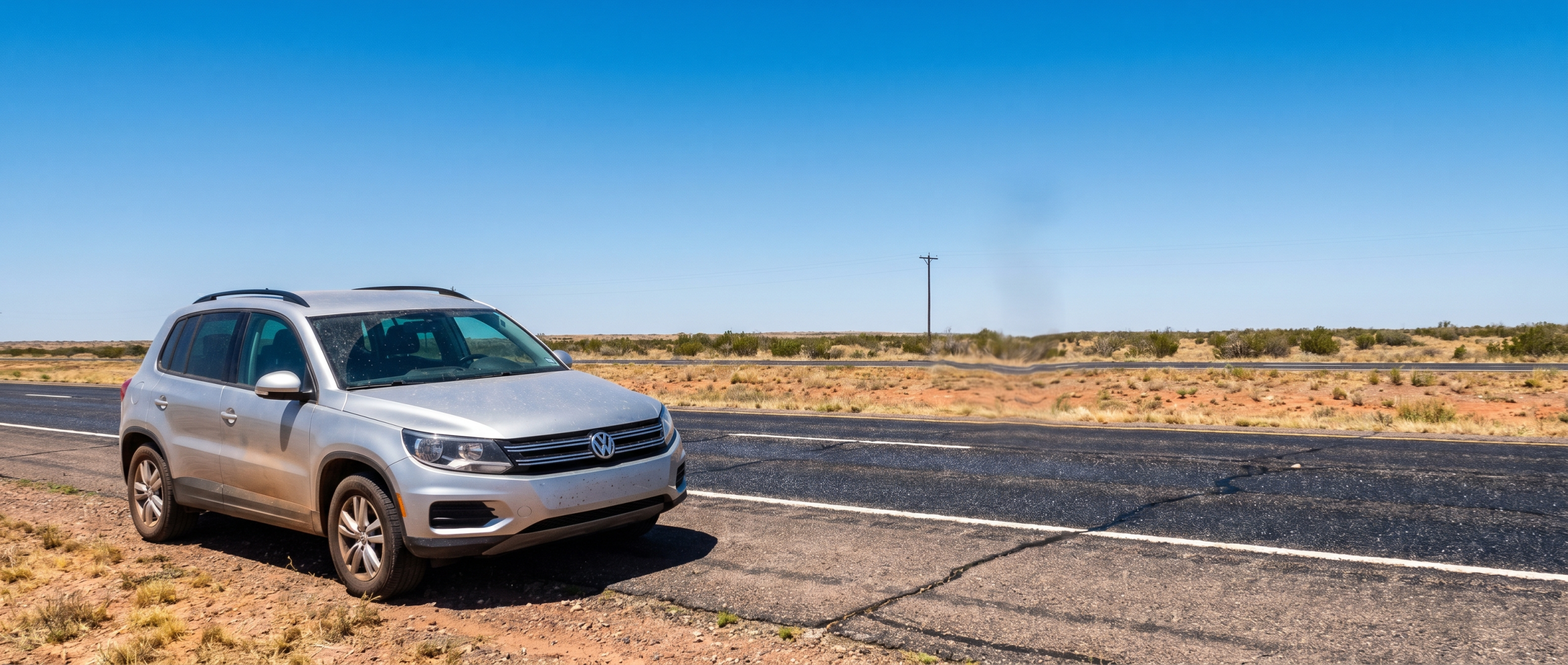
Asphalt surface temperatures in Amarillo, TX can exceed 150°F on a clear summer afternoon – and that kind of heat does things to your tires that most drivers never see coming until something goes wrong. If you regularly drive Loop 335, the stretch connecting the south side near Westgate Mall to the northwest corridor past Thompson Park, or anywhere across the Panhandle where exposed blacktop bakes under relentless sun, your tires are absorbing punishment with every mile. This guide covers exactly what that heat does to your Volkswagen‘s tires, how to stay ahead of the wear, and what signs to look for before a small issue turns into a roadside problem.
Why the Texas Panhandle Is Particularly Hard on Tires
The Panhandle’s combination of intense UV radiation, extreme heat differentials, and long straight roads at highway speeds creates one of the harshest tire environments in the country. Amarillo averages over 270 sunny days per year, and summer road surface temperatures consistently outpace air temperatures by 40 to 60 degrees. That gap matters because tire rubber compounds are designed with specific temperature tolerance ranges – and the harder you push those limits, the faster the rubber degrades.
What makes Loop 335 specifically demanding is the driving pattern it encourages. Long cruising stretches at speed build heat inside the tire. Then you slow for a light, the tire cools slightly, then accelerates again. That repeated thermal cycling – heat up, cool down, heat up again – breaks down the internal bonding of the rubber compound faster than consistent highway driving alone.
Drivers heading out to Palo Duro Canyon State Park on summer weekends face similar conditions: high-speed Panhandle highway driving with sustained heat exposure before reaching the canyon rim. Your tires carry that stress the whole way.
How Heat and Hot Pavement Damage Tires – What’s Actually Happening
Heat is the primary enemy of tire longevity, and hot pavement accelerates every form of tire wear simultaneously. Here is what is actually occurring inside your tire when Amarillo’s summer roads start cooking:
- Pressure expansion: Air inside a tire expands as it heats. For every 10°F rise in temperature, tire pressure increases roughly 1 PSI. On a 100°F day with 150°F road surface, your tires can run significantly overinflated compared to their cold-check baseline.
- Tread compound softening: Rubber softens under heat, making it more susceptible to abrasion from rough or aggregate-heavy surfaces like much of the asphalt you find along the Loop 335 commercial corridors.
- Sidewall stress: Heat weakens the sidewall’s internal structure over time. Potholes, sharp lane edge transitions, and the occasional rough railroad crossing near downtown Amarillo all hit harder when the rubber has already been softened by sustained road heat.
- Dry rot acceleration: UV exposure and ozone from Panhandle wind combine with heat to oxidize the rubber, causing dry rot to appear years earlier than it would in cooler climates.
- Blowout risk: Sustained highway heat combined with even slightly low inflation pressure creates the conditions for a heat-induced blowout. This risk is highest on long straight drives at consistent speed.
Understanding these mechanisms is the difference between reactive and proactive tire care. Once you know what to watch for, the warning signs become visible well before they become dangerous.
Tire Pressure Management in Amarillo’s Heat – The Right Approach
Managing tire pressure correctly in Amarillo’s climate is not as simple as checking the number on the sidewall. That number is actually the maximum pressure the tire can hold – not the recommended operating pressure. The correct pressure for your specific Volkswagen is on the driver’s door jamb sticker, and that number is what you should be targeting.
Here is the pressure management routine that holds up well in the Texas Panhandle summer:
- Check pressure in the morning before the vehicle has moved. Amarillo mornings, even in summer, are cooler and give you the most accurate cold reading.
- Use a quality digital gauge rather than the gas station air pump gauge, which are notoriously inconsistent and often read high.
- Account for seasonal baseline shift. Many Amarillo drivers inflate to the correct pressure in spring, then never revisit it. By August, ambient temperatures are 30 to 40 degrees higher, and daily thermal cycling has shifted your baseline.
- Check pressure before long highway drives, especially before heading out on I-40 or US-87 where you will hold speed for extended stretches.
- Do not deflate hot tires to reach the target number. If you check pressure mid-afternoon after driving Loop 335 and it reads high, wait until the tires cool before making adjustments.
Matching Your Volkswagen Model to the Right Tire Type for Panhandle Conditions
Not every tire performs the same way on Amarillo’s roads, and the model you drive should influence what kind of replacement tire you choose when the time comes. The table below matches common Volkswagen models to the tire characteristics that work best under Panhandle driving conditions.
| VW Model | Primary Use in Amarillo | Recommended Tire Priority | Heat Resistance Need |
|---|---|---|---|
| Tiguan | Family hauling, Loop 335 daily driving | All-season touring, wear-rated tread | High |
| Atlas | Highway family trips, I-40 corridor | Grand touring all-season, load-rated | High |
| Atlas Cross Sport™ | Mixed highway and city | Performance all-season | High |
| Jetta™ | Daily commuting, city driving | Standard touring all-season | Moderate-High |
| Jetta GLI™ | Sport commuting, spirited driving | High-performance summer or all-season | High |
| Taos™ | Urban and suburban daily driving | Touring all-season, fuel-efficient compound | Moderate |
| ID.4™ | EV daily driver, Loop 335 and beyond | EV-specific touring tire, low rolling resistance | High |
EV drivers in particular should pay attention here. The ID.4 runs heavier than a comparable gas-powered crossover due to its battery pack, which puts more load on tires at every temperature. EV-specific tires are reinforced to handle that weight and are formulated with compounds that manage heat from both the road surface and the regenerative braking system.
Rotation, Alignment, and Tread Checks – The Summer Maintenance Cycle
Tire care in Amarillo’s heat is not a once-a-year job. The combination of temperature stress, wind-driven road debris from the surrounding plains, and the stop-and-go conditions along Bell Street and Coulter Drive means your tires need consistent attention through the summer months.
Tire Rotation should happen every 5,000 to 7,500 miles under normal driving conditions. In a Panhandle summer, the front tires of a front-wheel-drive vehicle like the Jetta do significantly more work – steering, braking, and driving simultaneously. Without regular rotation, you will see front tires wear down noticeably faster, which is both a safety concern and a cost concern since uneven wear across an axle means replacing tires before their full potential tread life is reached.
Alignment checks matter more than most drivers realize. Amarillo’s roads, particularly near construction zones along Loop 335 and the utility corridor patches throughout midtown, take a toll on alignment over time. A vehicle that is even slightly out of alignment puts asymmetric pressure on the tire contact patch, and on 150°F pavement, that uneven stress accelerates tread wear rapidly.
Here is a practical summer tire inspection checklist to run monthly:
- ✓ Check tread depth with a quarter test (if Washington’s head is fully visible, tires need attention)
- ✓ Inspect sidewalls for bulges, cracking, or surface dry rot
- ✓ Look for uneven wear patterns across the tread width
- ✓ Check valve stems for cracks or missing caps
- ✓ Look for embedded objects like screws or gravel in the tread
- ✓ Verify TPMS sensors are functioning correctly
It is worth mentioning that it’s easy to schedule service at a Volkswagen dealership that understands these specific Panhandle driving demands when you want someone else to run through this checklist properly.
Signs Your Tires Are Struggling in the Amarillo Heat
Hot pavement wear does not always announce itself dramatically. More often, it builds gradually until a combination of stress factors triggers a problem at the worst possible time – like on I-27 heading south toward the Texas Tech University Health Sciences Center area during heavy traffic.
Watch for these warning signs that your Volkswagen’s tires are being pushed beyond their safe operating condition:
- Vibration at highway speed that was not there previously, especially noticeable above 60 mph on Loop 335
- Pulling to one side on a straight, flat road – a signal of uneven wear or alignment drift
- Visible tread wear indicators appearing level with the surrounding tread blocks
- Cracking or crazing on the sidewall – even fine surface cracks are a sign of UV and heat oxidation
- A persistent slow leak that requires you to add air every week or two
- Uneven wear across the tread width – wear on the outer edges only (underinflation) or center only (overinflation)
The Atlas Cross Sport and Tiguan, with their taller sidewalls compared to lower-profile performance tires, are actually somewhat more forgiving of Panhandle road imperfections. That said, taller sidewalls do not eliminate the need for regular inspection – they just change how damage tends to present itself.
Common Questions About Volkswagen Tire Care for Hot Pavement in Amarillo, TX
How often should I check my Volkswagen’s tire pressure during Amarillo summers?
Check your Volkswagen’s tire pressure at least once a month during summer, and before any long highway drive on roads like I-40 or US-87. Amarillo’s summer temperatures cause tire pressure to fluctuate more than in cooler climates – always check when tires are cold, meaning the vehicle has been parked for at least three hours. Use the pressure on your driver’s door jamb sticker as your target, not the number on the tire sidewall.
What tire pressure should I use for my Volkswagen in Amarillo’s heat?
Use the manufacturer-recommended pressure found on the driver’s door jamb sticker of your specific Volkswagen. This pressure accounts for the vehicle’s weight and load rating and is the correct operating target regardless of ambient temperature. Do not use the number printed on the tire sidewall, which is the maximum pressure, not the recommended pressure. Adjustments should always be made when tires are cold for an accurate reading.
Why do my Volkswagen’s tires wear faster in the summer around Loop 335?
Hot pavement softens the tire’s rubber compound, making it more susceptible to abrasion and wear. The stop-and-go driving pattern along Loop 335’s commercial corridors – accelerating and braking repeatedly on 140-150°F road surfaces – creates thermal cycling stress that degrades tires faster than consistent highway driving. Combined with Amarillo’s UV exposure and the road texture on heavily trafficked sections, summer tread wear can outpace what the same tires would experience in cooler climates by a notable margin.
When should I replace my Volkswagen’s tires in the Panhandle?
Replace your Volkswagen’s tires when the tread depth reaches 2/32 of an inch, when sidewall cracking or dry rot is visible, or when tires are more than six years old regardless of remaining tread. In Amarillo’s climate, the combination of UV exposure, heat, and ozone from Panhandle wind accelerates rubber oxidation – meaning age matters even if tread depth looks acceptable. A six-year-old tire with decent tread in Amarillo may be structurally compromised in ways that are not immediately obvious.
Does my Volkswagen ID.4 need special tires for Amarillo’s heat?
The ID.4 benefits specifically from EV-rated tires rather than standard all-season replacements. EV-rated tires are engineered for the ID.4’s higher curb weight from its battery pack, the increased torque that electric motors deliver instantly, and the heat generated through regenerative braking. On Amarillo’s summer roads, using a tire not rated for EV use can lead to faster-than-expected wear and compromised performance. Check with a Volkswagen service technician before selecting replacement tires for your ID.4.
Is it safe to drive on Amarillo roads to Palo Duro Canyon with older tires in summer?
Driving to Palo Duro Canyon State Park in summer with tires that have visible sidewall cracking, low tread depth, or a history of slow leaks carries meaningful risk. The drive involves sustained highway speed on sun-exposed roads before reaching the canyon, which builds internal tire heat significantly. If tires are borderline on any inspection point, have them professionally evaluated before making the trip. The canyon drive is rewarding – it is not worth taking on roads if your tires cannot handle the heat exposure.
Keeping Your Volkswagen Rolling Through Amarillo’s Summers
Hot pavement is simply part of life in the Texas Panhandle, and tires are where that reality meets the road most directly. Staying ahead of pressure checks, keeping up with rotation schedules, and knowing what early wear signs look like means your Volkswagen handles the Loop 335 summer commute, the run out to the Westgate Mall corridor, or the weekend drive to Palo Duro Canyon with confidence. The team at Street Volkswagen of Amarillo is equipped to help you evaluate your tire health, make the right replacement choices for Panhandle conditions, and keep your service schedule on track before the heat becomes a problem.
Connect with us


- June 2026
- May 2026
- April 2026
- March 2026
- February 2026
- January 2026
- December 2025
- November 2025
- October 2025
- September 2025
- May 2025
- April 2025
- March 2025
- February 2025
- January 2025
- November 2024
- October 2024
- September 2024
- August 2024
- July 2024
- May 2024
- September 2023
- August 2023
- July 2023
- May 2023
- November 2022
- September 2022
- August 2022
- July 2022
- June 2022
- April 2022
- March 2022
- September 2020
- August 2020
- July 2020
- June 2020
- May 2020
- April 2020
- March 2020
- February 2020
- January 2020
- December 2019
- November 2019
- October 2019
- September 2019
- August 2019
- July 2019
- May 2019
- April 2019
- March 2019
- February 2019
- January 2019
- December 2018
- November 2018
- October 2018
- September 2018
- August 2018
- July 2018
- May 2018
- April 2018
- March 2018
- February 2018
- January 2018
- December 2017
- November 2017
- October 2017
- May 2017
- April 2017
- March 2017
- February 2017
- January 2017
- December 2016
- November 2016
- October 2016
Archives
- Amarillo Volkswagen Dealer
- Amarillo Volkswagen Service
- Dealership Information
- Helpful Tips
- Just for Fun
- New Inventory
- Pre-Owned Inventory
- Press Release
- Service and Repair
- Street Volkswagen
- Street Volkswagen of Amarillo Service
- Uncategorized
- Volkswagen Information
- Volkswagen Model Features
- Volkswagen Tiguan
- VW Features
- VW News